Cruciform Hope
Still Breathing, and Maybe Actually Alive
Sick, depressed, and still embracing the gift of Jesus’ life
Published on Cruciform Hope, October 9, 2026
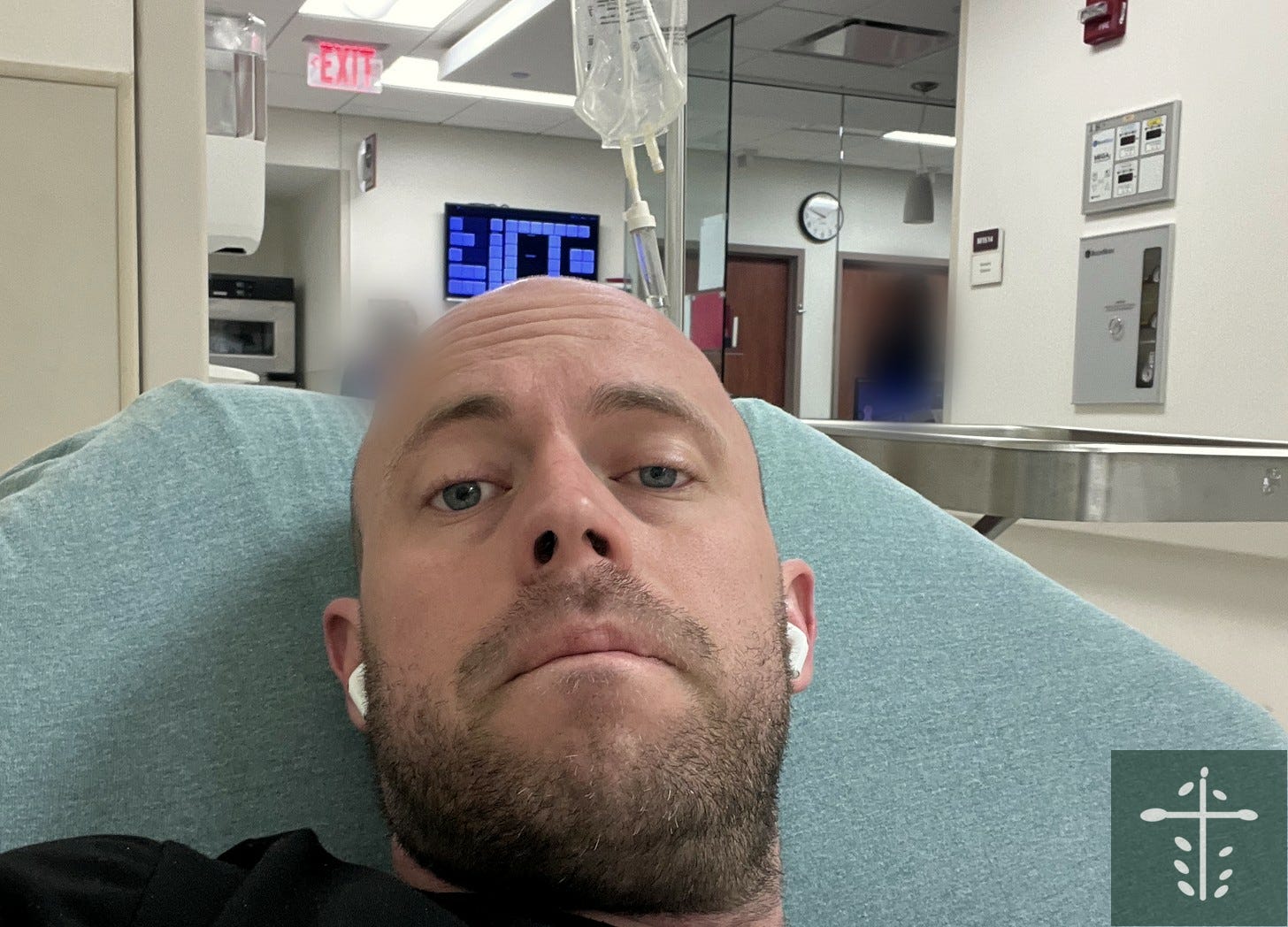
“Did you used to be a professional athlete?”
Surprisingly, that’s not a question I get asked a lot! Which made it all the more interesting that for an entire night I was asked a version of that question by about six different people on a random Wednesday about two months ago in room 622, fielding non-ridiculous questions from doctors trying to figure out why my pulse was too low for them to leave me alone.
I’m still reeling a bit, to be honest, and honesty is a big part of what I promise to give you here. I like to write for the person who feels like they are all alone, that no one has ever suffered like they have and that there’s no way anyone can ever understand them. I know what it’s like when your soul is struggling just to take a breath. I know what it’s like to try to care for the person who just wants to feel alive, but can’t seem to stop drowning. I’ve been both of those people, and since my stay in the hospital, I’ve been having a hard time.
A large part of my ministry is built around confessing my own struggles with mental illness and still that last sentence was hard for me to write. It will be harder to publish.
I’ve always wanted to be full of joy and vitality like the people I see around me every day, and yet for much of my life it’s felt like I’m treading water to keep breathing. One of the things that draws me to the Jesus I meet in the Gospels is his promise of abundant life, even (especially) to those in places of pain and darkness and shame and hopelessness.
“The thief comes only to steal and kill and destroy. I came that they may have life and have it abundantly.” (John 10:10, ESV)
One of the insidious things about suffering is that it narrows our focus, diminishing our ability to be aware of and awake to the promise and presence of God’s life-giving Spirit. And that’s exactly what I’ve been struggling with these past couple of months.
How It Started
I was in a full sprint, preparing for an amazing year of Spiritual Life at the high school I’m privileged to work at as one of two chaplains. But I was losing weight at an alarming pace. Unintentionally, I was losing at least 5 pounds every week for well over four weeks. Being sick in a way that causes large and quick weight loss is kind of like having a disease where every morning you find a $500 check. It’s not the most sympathetic situation. I get it. But it doesn’t change the intense wave of fear that accompanies that step onto the scale for the fifth week, wondering how much more of your body there is left to disappear. Questioning how much more abdominal pain you can manage and how much longer you can lead meetings and act like a normal person while internally you are running on the fumes of whatever strength or energy or stamina you have left.
The night before our first day of school, I was curled up in the fetal position on our living room floor, crying and debating with my wife about whether I needed to go to the ER. It really felt like I had to push through whatever was happening to me for at least one more week because of my commitments to our school and students. My wife looked more concerned than I had seen her in a long time and asked me, “Do you really think you should try to push through this?” I knew the answer, and so I called my head of school, sent a text to my parents, and got into the car.
That ER visit turned into a four-night stay in the hospital. I’ve never actually been admitted to a hospital and I’ve certainly never spent the night as a patient. It is rough. I was eventually diagnosed with a GI disease, but all things considered, the test results and procedures were really good news.
The Hospital Stay
The hospital is not a fun place to be. It can be boring, uncomfortable, scary, exciting, or just weird. Like the night that machine wouldn’t stop beeping because my pulse kept causing alarms to ring out and every doctor, nurse, or visitor at the hospital apparently had to come observe the tiny man with the pulse of a champion, but not the athletic history of one.
The first time I got asked that question I was kind of flattered. It was the nurse in my room at 9 p.m. I never knew a hospital could be such an encouraging place. I thought about never leaving. At 11 p.m. the question changed to “Did you used to be in really good shape?” It was a step down, and I noticed. Still a compliment. At 1 a.m. I was asked if I had played sports in high school. And by 3 a.m. they had two techs come in independently to make sure the monitor was working because they were pretty sure the machine was just malfunctioning. In less than six hours I went from a former professional athlete to an equipment failure. Life comes at you fast.
This monitor could track every beat of my heart and still couldn’t tell them more about what was really happening inside of me. My soul can do the same thing. Hold a pulse but not be actually alive. I usually know when it’s happening and I know something is wrong. But I don’t know why. And I don’t know how to fix it.
After my time in the ER and before I was rolled into my hospital room, I spent six hours on a bed in the hallway of the hospital’s trauma ward. What can I say, they roll out the red carpet for the rich and famous. At one point my intestines began to lock up and twist to create an increasingly familiar and unbearable pain.
As I cried out for help in an already chaotic hallway, doctors and nurses who didn’t know me scrambled to address my pain. At some point a gentle man kneeled down next to me, squeezed between two annoyed-looking nurses, and asked if he could pray for me. It wasn’t the best prayer I’ve ever heard and I’m sure it wasn’t the most contemplative posture of prayer I’ve ever assumed before, but somehow the Spirit began bringing awareness of the truth that I wasn’t alone. That even in the hallway of the trauma ward with my guts contracting in pain, I was known by the God of Abraham, Isaac, and Jacob. The One who draws close to the suffering. The God whose face shines like that of the man from Nazareth who was crucified and rose. Abundant life didn’t take away my pain. Abundant life met me in my pain. I didn’t learn anything new, nor was I healed, but something shifted inside me like bags in the overhead on a plane.
Fast forward a few days, and I found myself alone in my hospital room after yet another procedure. I was pretty down. My wife was at work and I hadn’t seen my daughter in person for a couple of days because she found the hospital a scary place. I could feel a darkness rising inside me that would ultimately sit on my chest like a 50-pound weight, one that I hadn’t experienced in many years, and I decided to just try and sleep the day away instead of ruminating into a deeper depression that I know can be hard to pull yourself up out of. While I slept, I missed a dozen calls and texts from my friend Michael trying to come visit me. He had actually driven to a hospital downtown to visit me, without realizing I’m a suburban kid and was at a different location of the same hospital system about 25 miles southwest. The front desk told him they had a high level of confidence his friend wasn’t there because the 6th floor of the hospital he was at was the labor and delivery ward. That wouldn’t deter him though. Despite the mix-up, he drove down to where I was and walked into the room as I was sleeping away my sorrow.
I remember feeling a hand on my shoulder and hearing my friend say, “Hey Mike, I’m here for you. You keep resting, and I’m just going to go sit quietly in the chair over there.” My initial reaction: I don’t want you here. I want to be sad. I want to sleep. But I slowly woke up and we began talking and as we laughed and shared stories and prayed together I was again woken up to the truth of God’s faithfulness and the abundant life I had access to even (especially?) in the midst of pain and suffering.
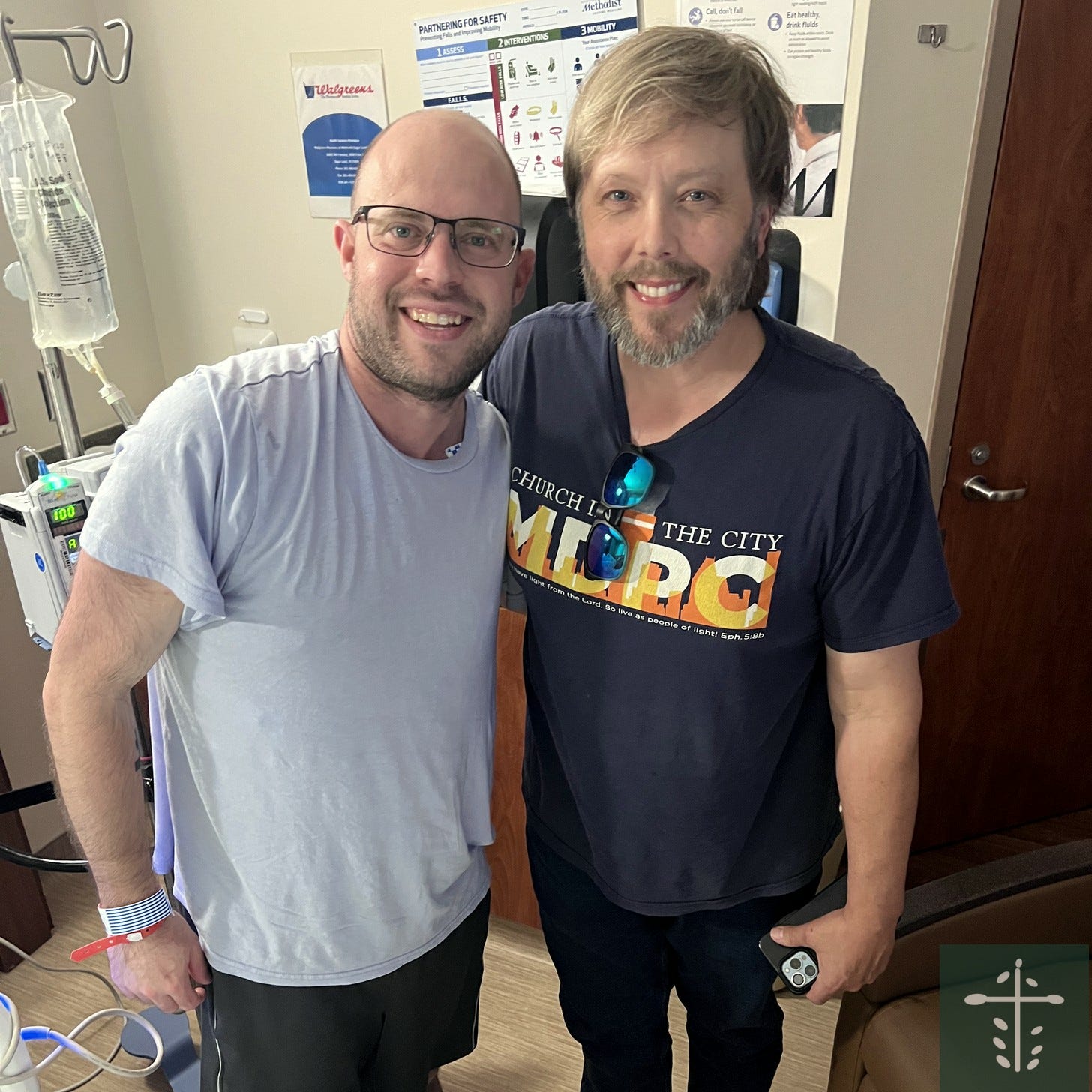
The man who prayed with me in that hallway turned out to be one of the chaplains at the hospital. Michael has been a good friend for many years. Neither one of them told me anything I didn’t already know. Their faithful presence and prayers did something simple but powerful: they helped me wake back up to a truth I had lost sight of. I was drawn back into an old practice of prayer I learned many years earlier that had been a powerful way for me to remain aware of God’s loving presence in my daily life.
The Flood
Less than 48 hours after my discharge, I went downstairs late at night after my family was asleep, and took a step in the dark and found my foot in a few inches of water. I didn’t know it at the time, but it was sewage water. My brain didn’t need more than a half-second to fire up the type of panic you can feel all the way to the edge of your toes. In 2021, Winter Storm Uri caused a power outage at the same time as a freeze and the pipes in our house then froze, burst, and collapsed half of our ceilings. I’m not a fan of water damage.
It turned out that a company had been digging in our backyard while I was in the hospital and had broken our drain line, causing wastewater to back up for a few days until it finally overflowed back into our home. Our lives, which had just begun to flirt with normal, were immediately thrown into chaos again. Within an hour men in hazmat suits were at our house. And so I found myself rolling out of an uncomfortable bed one morning in an extended-stay hotel after a few hours of fairly lousy sleep, putting on the literal last pieces of clean (albeit baggy) clothes I had, to head to campus to preach on John 10:10 for our first chapel of the year. There was some real nervousness about the prospect of staring at hundreds of students and staff members to talk about the gift of living an abundant life in Christ when I was barely able to take a deep breath.
I retreated to a private room to review my notes and spend time in prayer before service began. As I reviewed my notes, I began choking up again and again. They were tears born of fatigue and pain, but mixed with a deep gratitude at the clear evidence of how the Lord had consistently met me in my time of need. I hadn’t planned on having any emotional moments in my message, but I quickly realized I had laid a bunch of emotional trip wires for myself in the course of preparing the sermon. I think it’s kind of a niche specialty I have as a speaker. I’m pretty good at giving the vulnerable, post-tragic moment story.
When worship started, I knew I was locked in. Michael (yes, that Michael) was there to lead it and I had a strong sense of the presence of God’s Spirit. I got up and explained that being spiritually alive wasn’t the same as happiness, or enthusiasm, or a life devoid of hardship. And likewise, to be just breathing isn’t the same as being depressed or anxious or grieving. The difference isn’t emotional intensity or external circumstances. It’s simply this: are you aware of and responding to the presence of the Father?
I did my best to tease out the truth that often those withering on the inside actually look pretty alive to others. You can be busy and successful and impressive. But on the inside, maybe you’re running on autopilot. You’re not truly alive. You’re kind of just breathing. The pulse is there, but there’s some kind of functional numbness that’s blocking joy or peace. It’s the exact same thing that was going on with the machine in room 622.
The message landed well, tears and all, and I then limped through the rest of the week, telling the same stories over and over and repeating a tired line: “I’m struggling, but I’m making it.” Friday afternoon I got a phone call that sent me into a panic attack and that panic attack sent me into a spiral over the weekend. I had just taught on the practice of attuning oneself to the presence of God through prayer in order to enjoy the life of Jesus, and yet I was already assuming that the coming weekend was going to be a horrible one, the kind I look back on with guilt and shame because I am not able to show up for my wife and daughter the way I want to. I knew I was heading toward a weekend of doomscrolling while watching TV and allowing my stress and anxiety to spread to the people around me. I was falling into depression.
Still, I faithfully trotted out my stock answer: “I’m struggling, but I’m making it.”
Life Finds a Way
What I stopped doing that week is what I had asked the students and staff to do in my message: practice a form of the Examen prayer. It’s the same tool I had resumed after my visit with Michael in the hospital. The Examen requires you to be honest about what parts of your day bring you spiritual comfort and what parts of your day are marked by spiritual discouragement or distraction. Honest self-examination can be frightening. It’s also freeing.
The next week I was in my office early one morning, stressed and overwhelmed at the pile of work in front of me that I wasn’t sure how to dig myself out of. A parent stopped by to check on me and sat down to talk. I gave her the sanitized, less-than-honest version of how I was actually doing. I had already been hyperventilating about not having enough time to catch up on important tasks and I wasn’t looking forward to hearing platitudes about how good God is. But instead, she listened, acknowledged how hard my experience must have been and how difficult it must still be. At the same time, she gently refused to allow my circumstances to dampen her hope that the Lord’s faithfulness can be counted on and that his creation is so incredibly good, including our sometimes dysfunctioning bodies. She left and I sat in silence. No longer worried about squeezing productivity out of every second of that morning. I spent some time tearfully thanking God for her unexpected visit and comforting presence.
Like the hospital chaplain and my friend Michael, she didn’t say anything I hadn’t heard before or said myself. But it had a contagious effect and I felt the Spirit hook onto my soul. I recommitted myself to practicing the Examen prayer each day. I also knew it was time for me to get more help and began weekly therapy sessions again. Therapy has helped me process the experience and manage my stress. The Examen has helped me stay awake, for longer periods of time, most days, to the reality of what I knew was already true about the good news of Jesus, who brings life not by avoiding death but by entering into it to defeat it from the inside. Jesus provides a unique type of hope to me in my suffering: a cruciform, or cross-shaped, hope.
Where I Stand
We’re back home now and I’m learning to manage my illness while doing my best to fulfill my commitments. I haven’t experienced perfect progress. But I am moving forward.
One thought keeps ringing in my ears. What a shame it would be to sleepwalk through life, consumed with our very real scars and scabs, all while a gentle man from Nazareth keeps kneeling down next to us, placing his hand on our shoulder, and pulling up a chair to listen.
One of the things I like most about the Examen is its emphasis on the gifts of God that can be found in almost every moment of our lives. Even on your worst day, you can find examples of the Triune God being gracious to you. Sometimes in small ways. And sometimes in more obvious ways.
Like the nurse at 9 p.m. who I am so grateful for.
She knows an athlete when she sees one.
Notes, credit, and a few rabbit holes
The Examen is a short daily prayer that St. Ignatius of Loyola wrote about in Spiritual Exercises in the 1520s. I was taught it by a spiritual director I sought wisdom from during a spiritually dry season in my life when I was pastoring a local church. You can try it tonight by following this prayer card that I’ve used and often share with others. There’s also an app called Reimagining the Examen which I’ve heard good things about, though I’ve not personally used it. The book I most often recommend to those interested in learning more about it and growing in their practice of this spiritual discipline is Timothy M. Gallagher’s The Examen Prayer: Ignatian Wisdom for Our Lives Today.
A quick note for the interested and the subscribed: I’ll be returning to my previously scheduled material next week, finishing up the series on parenting with three more articles and then moving on to some new topics.
I’m happy you are here, would love for you to share this with someone you know who might appreciate it, and I hope you’ll stick around for what is to come.
Get the next one in your inbox.
Cruciform Hope is a free newsletter on faith and mental health.